

We use essential cookies to keep you signed in and remember a guest player in this browser. Google’s ad code uses cookies too. Cookies
From Ur to TD-Gammon
The History of Backgammon
In 1283, a book of games was finished in Seville for King Alfonso X of Castile. One of its games starts from the position you see when you open a backgammon room today. The idea of racing pieces by the roll of dice is far older than that book, and the doubling cube is far younger. The story runs through Mesopotamian boards, a Roman emperor’s bad roll, a Persian court tale, London print shops, New York clubs and a program that taught itself to play.

Dice and a race, 4,500 years ago
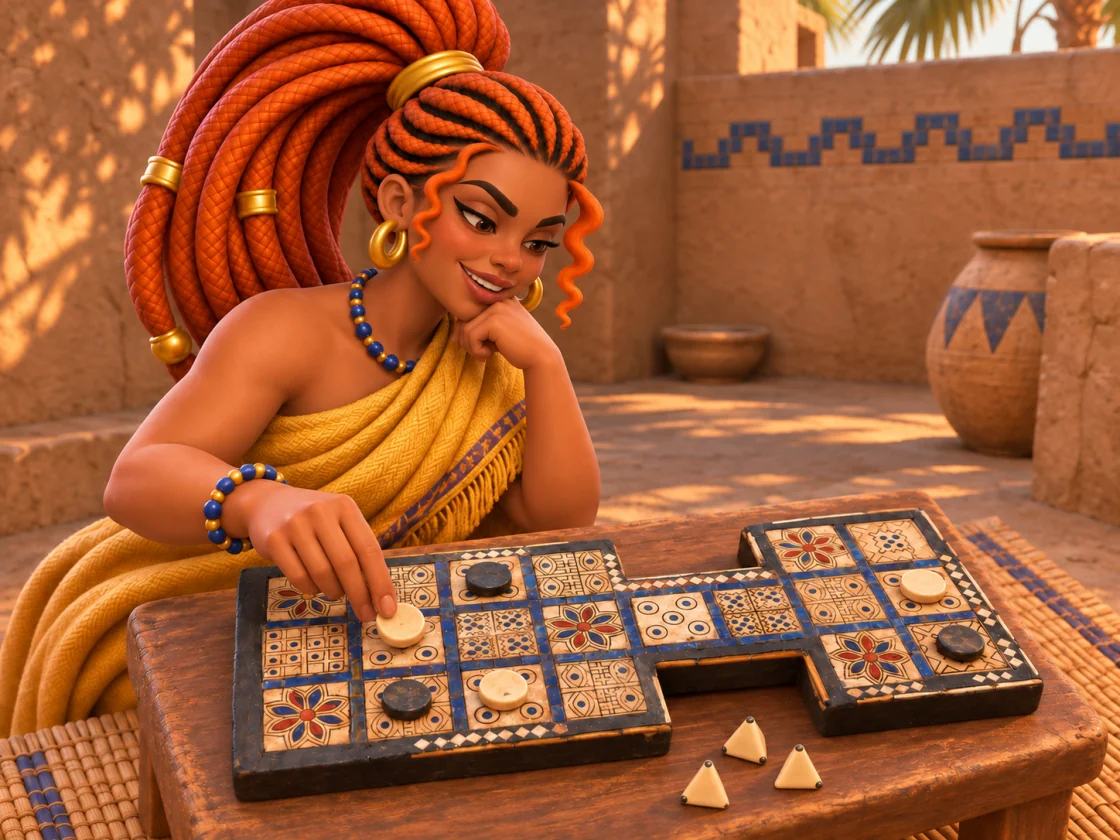
In the 1920s, Leonard Woolley excavated the Royal Cemetery at Ur, in what is now southern Iraq, and found inlaid game boards with twenty squares. The British Museum dates its board to about 2600–2400 BCE. Two players raced seven pieces each across the squares, and the throws came from four-sided dice. A carved wooden board from a cemetery of about the same age at Shahr-i Sokhta, in eastern Iran, belongs to the same game.
The game lasted. More than one hundred boards are known, from Iraq and Iran to Egypt and Crete. A clay tablet written in Babylon in 177–176 BCE by the scribe Itti-Marduk-balatu records throws and lucky squares for it. Irving Finkel, who studied and translated the tablet, calls it by far the oldest surviving example of rules for a board game. Even so, the tablet covers only part of the play. The rule sets people use for the Royal Game of Ur today are reconstructions.
These boards show that people were rolling dice to race pieces around a track long before backgammon existed. They don’t give backgammon a family tree. Older backgammon books also name the Egyptian game senet as a forerunner. Both claims rest on resemblance, and nobody has traced a line of descent from either game to the backgammon board.
Twelve lines, three dice and Zeno’s bad roll
Roman players carved boards for a game called ludus duodecim scriptorum, the game of twelve lines. It dates to the first centuries CE. Surviving boards have three rows of twelve spaces. Some spell out six-letter words in place of the spaces, and one tells a losing player to get up and get lost. No ancient rulebook survives. Roland Austin and H. J. R. Murray worked out the likely basics in the twentieth century, with three dice and fifteen pieces a side, partly by borrowing from a later game.
That later game was tabula, the source of the old English name “tables.” Its best record is a poem. Agathias describes the fifth-century emperor Zeno sitting at a game with most of his men safely paired. Zeno threw three dice and got 2, 6 and 5. The throw broke up his pairs and left eight men standing alone, each one a blot. The poem ends by warning the reader to stay away from the game.
Scholars have used the poem to rebuild tabula. In their reading it had twelve points on each side of the board and fifteen men for each player, and two or more men on a point kept an opponent from landing there. A backgammon player would recognize all of that. The differences matter too. Tabula used three dice, and its men started off the board. Austin, who studied the poem in 1934, cautioned that the Greek name covers a family of table games and is not exactly backgammon.
A Persian court tale and a game that traveled
A short Middle Persian text tells the best-known story about nard. An Indian king sends a chess set to the court of the Sasanian king Khosrow and dares the Persians to explain it. The sage Wuzurgmihr works out the game, then invents one of his own to send back, and the Indian sages can’t solve it. He names his game for King Ardashir. Later Persian tradition, including the Shahnameh, calls that invention nard.
The text reads the game as a picture of the cosmos. The board is the earth. The thirty pieces are the days and nights of a month, fifteen white and fifteen black. Their movement follows the turning of the stars. The story can’t be taken as a record of who invented the game, and where nard began is still debated. One scholar has pointed to the Roman twelve-line game as a possible source. A 2020 study describes an older text, from the fourth century or earlier, that tells the tale with different people.
Firmer ground comes later. Nard has a documented history going back to at least 600 CE. As later recorded, each side has fifteen pieces on a track of twelve points per side, a lone piece can be hit, and the game ends with bearing off. Relatives of nard reached as far as Japan. Twentieth-century backgammon histories say the Arabs learned the game from the Persians and that Crusaders met it in the Near East, though a tables game already appears in English glossaries of the eighth and ninth centuries.
Medieval tables and Alfonso X’s book
The clearest medieval record is a book you can still see. The Libro de los Juegos was begun and finished in Seville in 1283 for Alfonso X of Castile. It has three main parts. Chess stands for intellect, dice stand for chance, and tables combine the two. Its painted miniatures show men and women of the court at the boards.
One of the tables games in the book is todas tablas. Each player has fifteen pieces and starts with five on the 6 point, three on the 8 point, five on the 13 point and two on the 24 point. That is the backgammon starting position. The players move in opposite directions on the roll of two dice, a single piece can be hit and sent back, and the first to bear off every piece wins. The Digital Ludeme Project describes it as the tables game that most closely resembles modern backgammon.
Tables was a family name. H. J. R. Murray counted at least twenty-five kinds played in medieval Europe. The dice made rulers and clergy uneasy. In 1190, Richard I of England and Philip of France limited how much their crusading knights could lose in a day. In 1254, Louis IX of France banned the game for his court officials and then for all his subjects. The bans didn’t hold. By the end of the 1400s, many towns tolerated tables as long as the stakes stayed small.
A new name in the 1600s, a treatise in 1743
The word “backgammon” turns up in English in the middle of the 1600s. An Oxford dictionary cited by Oswald Jacoby and John Crawford gives 1645 as its earliest recorded use. In the 1660s, Francis Willughby described a tables game called Irish and a variation called Back Gammon. Irish was close to the modern game. Back Gammon changed two things. Doubles were played twice over, and a lopsided win counted for more than a single game, the idea behind the gammon.
Where the name came from is unsettled. The usual explanation joins the Middle English words for “back” and “game.” A Welsh origin has also been proposed. H. J. R. Murray, the historian of board games, concluded that backgammon was an English invention of the early 1600s, a new form of tables. The old name hung on. Samuel Pepys wrote in his diary for September 21, 1665, about losing a crown betting at tables.
In 1743, Edmond Hoyle published A Short Treatise on the Game of Back-Gammon in London, a year after his book on whist. It gives a table of the thirty-six chances on two dice and shows how to find the odds of being hit. It also covers bringing your men home, playing a back game, and when to run to save a gammon, and it ends with the laws of the game. Players were already working out the trade-off you face today when you leave a blot to make a stronger move.
New York clubs raise the stakes
Interest in backgammon revived in the 1920s, when players in American clubs began offering to double the stakes in the middle of a game. The opponent could accept and play on for twice as much, or refuse and lose at the current stake. Researcher Albert Steg’s best guess is that the practice began in New York around 1925. The earliest book he found that describes it is Grosvenor Nicholas’s Modern Backgammon, from 1928.
At first the doubles were simply spoken. By 1929, players were keeping count with matches. The earliest known picture of a doubling cube is in a Marshall Field advertisement in the Chicago Tribune of May 26, 1930. Nobody knows for certain who thought of doubling or of the cube. A 1930 New Yorker piece credited Grand Duke Dmitri of Russia. Two histories of New York’s Racquet and Tennis Club name two different members. Nicholas claimed the cube for himself in 1931. Jacoby and Crawford simply credited an unknown genius in one of the American clubs.
In 1931, Wheaton Vaughan of the Racquet and Tennis Club invited other clubs to help write a common set of laws. Those laws covered doubling and the scoring of big wins. A gammon counts double and a backgammon counts triple. They are the basis of the rules played today. LarkSpark leaves that layer out. Each room is a single game with no cube, and a win is a win. The rules chapter has the details.
Obolensky, Las Vegas and Monte Carlo
In 1964, Prince Alexis Obolensky organized an international backgammon tournament in the Bahamas. The U.S. Backgammon Federation counts it as the first ever held. Charles Wacker of Chicago won. Obolensky wanted a tournament circuit, famous players and press coverage, and he got all three. He founded the World Backgammon Club in 1967 and that year staged the first event titled a World Championship, at the Sands Hotel in Las Vegas. Tim Holland won it.
The 1970s were the boom years. The Backgammon Book by Oswald Jacoby and John Crawford came out in 1970. Paul Magriel’s Backgammon followed in 1976 and became known as the bible of the game. Magriel won the world title himself in 1978. A timeline from The Gammon Press puts the peak between 1977 and 1981, when a single one-night event could draw 150 to 200 players.
For a few years there were two big titles. A European Championship ran in Monte Carlo from 1976 while the official World Championship was held in the Bahamas. In 1979, promoter Lewis Deyong combined the two into a single event in Monte Carlo. Luigi Villa of Italy won it, beating Jeff Westheimer 25–22 in the final. Records from the early years are patchy, and sources disagree about a few of the venues and winners.
Programs that beat, then taught, the experts
On July 15, 1979, in Monte Carlo, a program called BKG 9.8 played the newly crowned world champion Luigi Villa. It was an exhibition match to seven points, winner take all, for $5,000. The program won 7–1. Its author, Hans Berliner of Carnegie Mellon University, was candid about the result. He wrote that the program had somewhat the better of the dice and that Villa was certainly the better player. By his analysis, Villa made no serious errors and the program made two.
In the early 1990s, Gerald Tesauro of IBM tried a different approach. His program TD-Gammon was a neural network that started with random weights and learned by playing against itself, using the final result of each game as its feedback. One network given only the raw board layout trained on 200,000 games. In late 1991, version 1.0 played fifty-one games against Bill Robertie, Paul Magriel and Malcolm Davis and lost by thirteen points. In 1992, version 2.0 played thirty-eight games against top players and lost by seven.
The program also changed how its opponents played. With an opening roll of 2-1, 4-1 or 5-1, experts had long moved a checker from the 6 point to the 5 point, a slot. TD-Gammon’s analysis favored splitting the back checkers by moving one from the 24 point to the 23 point, and tournament players switched. Commercial neural-network programs followed, beginning with Jellyfish in 1994. Snowie arrived in 1998 and Extreme Gammon in 2011.
Sources
- The Royal Game of Ur · British Museum
- Senet as a forerunner · The Backgammon Book, Jacoby and Crawford
- Boards and reconstructed rules · J. Paul Getty Museum
- Agathias’s poem on Zeno’s game · Greek Anthology 9.482
- Zeno’s game of tabula · The Journal of Hellenic Studies
- From tabula to backgammon · Masters Traditional Games
- The Middle Persian text in translation · Avesta.org
- Backgammon and cosmology at the Sasanian court · Bulletin of SOAS
- Chess and backgammon in ancient Persia · Iranian Studies
- Nard · Digital Ludeme Project
- The 1283 manuscript · Royal Library of El Escorial
- Todas tablas · Digital Ludeme Project
- Tables in the Middle Ages · The Backgammon Book, Jacoby and Crawford
- The word and its early uses · The Backgammon Book, Jacoby and Crawford
- Hoyle’s 1743 treatise · Books on Gaming
- Early doubling and the first cubes, by Albert Steg · New England Backgammon Club
- The 1931 Laws of Backgammon · Backgammon Galore
- Prince Alexis Obolensky · U.S. Backgammon Federation
- World championship venues and winners · Backgammon Galore
- A short history of modern backgammon · The Gammon Press
- Backgammon Computer Program Beats World Champion · Artificial Intelligence, 1980
- Temporal Difference Learning and TD-Gammon · Communications of the ACM, 1995