

We use essential cookies to keep you signed in and remember a guest player in this browser. Google’s ad code uses cookies too. Cookies
15 centuries of chess
The History of Chess
Chess is about 1,500 years old, and no single person invented it. It grew out of an Indian war game, was reshaped in Persia and the Arab world, and took its modern form in Europe a little over 500 years ago. This page follows that journey up to the present day.

Chaturanga: an army on a board
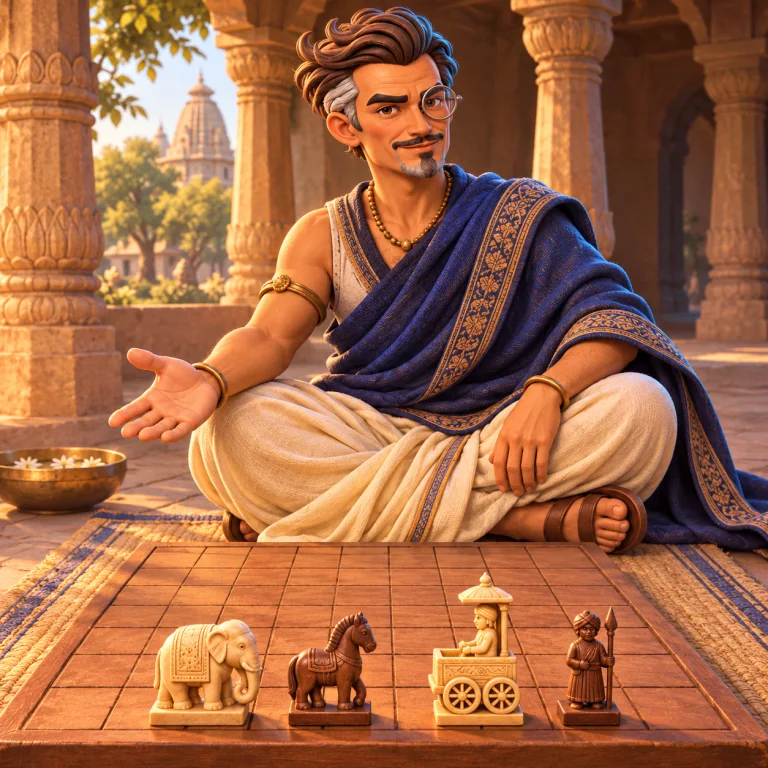
Most historians trace chess to northern India, where a game called chaturanga was being played by about the sixth century. The name is Sanskrit for “four limbs” and referred to the four divisions of an Indian army: infantry, cavalry, elephants and chariots. Each division became a piece, and they are still on the board today as the pawn, the knight, the bishop and the rook.
Chaturanga was played on an eight-by-eight board that was already in use for older race games. What set it apart from those games was that different pieces had different moves, and that everything depended on the fate of one piece, the king. Both ideas are still the heart of chess.
Very little is known for certain about the earliest rules. The first clear written references to the game date from around the start of the seventh century, by which time it was already traveling west.
Shatranj: Persia and the Arab world
From India the game passed to Persia, where it was called chatrang. After the Arab conquest of Persia in the seventh century it spread through the Islamic world under the Arabic name shatranj. Several chess words come from this period. “Check” goes back to shah, the Persian word for king, and “checkmate” to shah mat, usually translated as “the king is helpless” or “the king is defeated”. “Rook” comes from rukh, the Persian name for the chariot.
Shatranj would be recognizable to a modern player, but it was a much slower game. The king, rook and knight moved as they do now. The piece beside the king was a counsellor that moved one square diagonally, and the elephant jumped exactly two squares diagonally. Pawns moved one square at a time, even on their first move, and could only promote to a counsellor. A player could also win by capturing all of the opponent’s pieces and leaving the king alone.
In 9th- and 10th-century Baghdad, shatranj was studied seriously. Masters such as al-Adli and as-Suli wrote books about it, worked out standard opening arrangements, and composed problems with a set task, such as forcing mate in a given number of moves. This is the beginning of chess literature.
The game reaches Europe
Chess entered Europe by more than one road: through Muslim Spain and Sicily in the south, and along trade routes from Byzantium and the east. It was known in western Europe by about the year 1000. One of the earliest European descriptions is a Latin poem written at Einsiedeln Abbey, in what is now Switzerland, around the end of the 10th century.
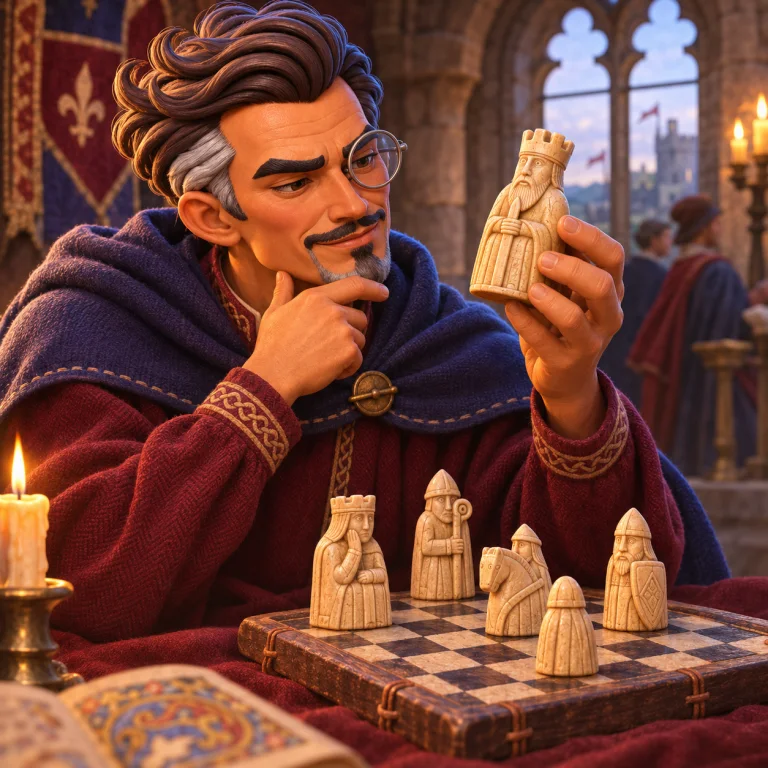
During the Middle Ages chess became a favorite pastime of courts and monasteries, and a standard part of a noble education. The pieces were renamed to fit European society: the counsellor became the queen, the elephant became the bishop in English, and the chariot kept its Persian name as the rook. The Lewis chessmen, carved from walrus ivory in the 12th century and found on the Scottish island of Lewis in 1831, show kings, queens, bishops and knights as medieval Europeans imagined them.
Europeans also began to change the rules to speed the game up. Boards were now checkered in two colors, which made diagonal moves easier to see. Pawns were allowed a double step on their first move. In 1283 King Alfonso X of Castile commissioned a richly illustrated book of games that records chess as it was played at his court, along with many chess problems.
The 1400s: the queen and bishop are set free
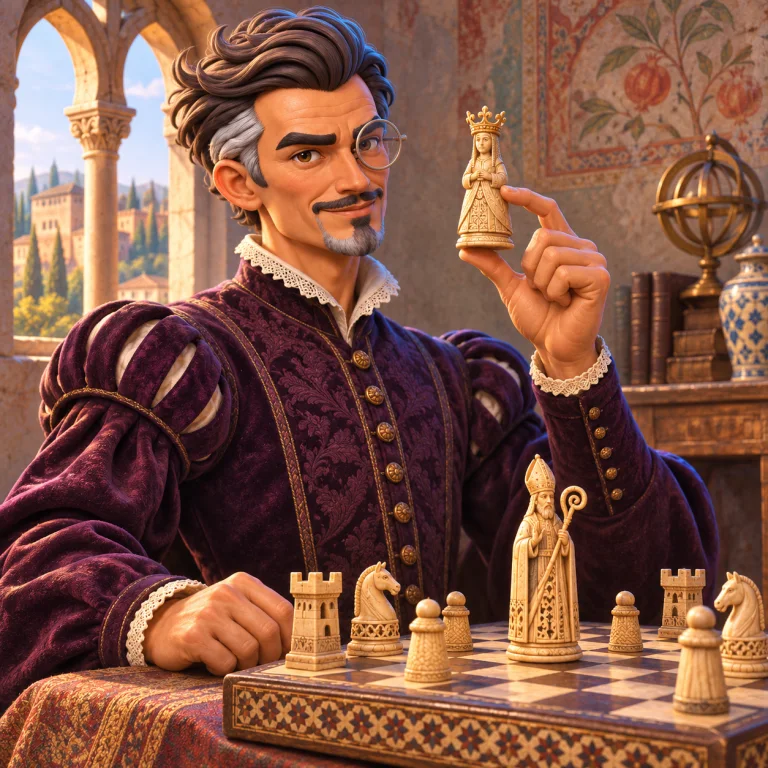
The biggest change in the history of chess came in the last quarter of the 15th century, most likely in Spain. The queen, until then the weakest piece on the board, was given the combined move of the rook and bishop and became the strongest. The bishop, which had hopped two squares, was allowed to travel the full length of a diagonal.
The effect was dramatic. Attacks could now arrive in a handful of moves, a careless player could be checkmated almost from the starting position, and pawn promotion became far more valuable because a pawn could turn into the new queen. Contemporaries called it “queen’s chess”, or less politely “mad queen’s chess”. Within a generation or two it had replaced the old game across Europe.
The new rules also created opening theory, because early moves suddenly mattered. Luis Ramírez de Lucena published the oldest surviving printed chess book in Spain in 1497, and the Spanish priest Ruy López de Segura published a far more thorough one in 1561. The opening named after him, the Ruy Lopez, is still played at every level.
One set of rules, one way to write them down
For a long time after the queen’s new move, the finer points of the rules differed from country to country. Castling grew out of an older rule that let the king make one leap, and it was done in several ways; Italy kept its own freer form into the 19th century. The en passant capture and the question of what a pawn could promote to were also treated differently in different places. Even stalemate was not always a draw: in England it counted for a time as a win for the player who had been stalemated.
As travel and correspondence between clubs increased in the 18th and 19th centuries, these differences were gradually ironed out. In 1749 the French master François-André Danican Philidor published his Analysis of the Game of Chess, one of the first books to explain strategy in general terms and the source of the saying that pawns are the soul of chess.
Equipment and notation were standardized as well. The familiar Staunton chess set was designed by Nathaniel Cooke, registered in 1849, and endorsed by the leading English player Howard Staunton; it remains the standard pattern for competition. For recording moves, English- and Spanish-speaking players long used descriptive notation (“pawn to king’s fourth”), while much of Europe used algebraic notation, which names each square by a letter and a number. Algebraic notation is now used everywhere and is the only system recognized by the world chess federation.
The first tournaments and the chess clock
In the early 19th century the strongest players met in long individual matches, often in coffee houses such as the Café de la Régence in Paris. The first international tournament was held in London in 1851, organized by Staunton and won by the German master Adolf Anderssen. A few years later, in 1858, the American Paul Morphy traveled to Europe, defeated Anderssen and nearly everyone else he played, and then gave up serious chess while still in his early twenties.
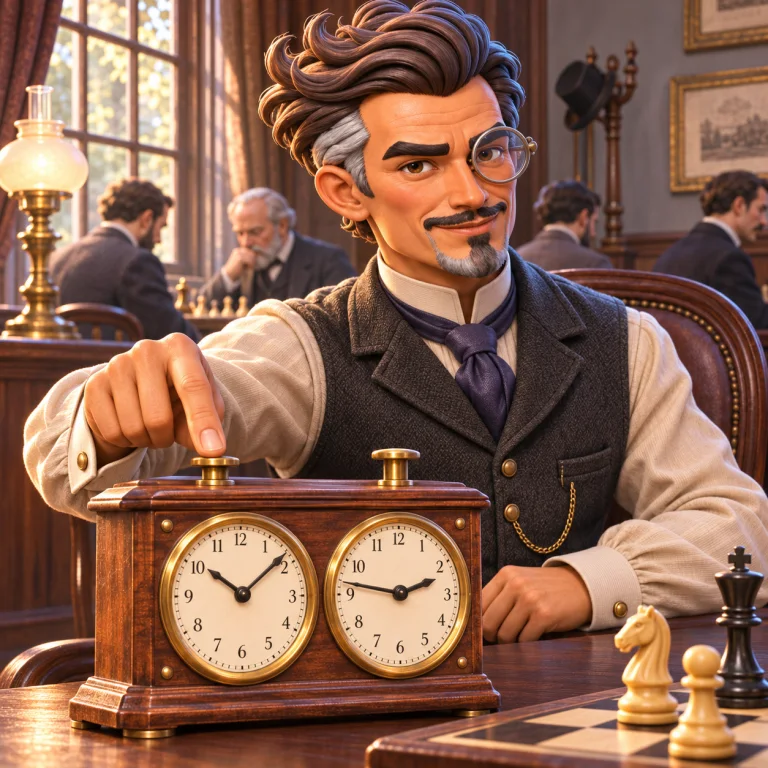
Early tournaments had no time limit, and some games dragged on for many hours. Organizers first tried sandglasses, and then mechanical clocks. A double clock, in which pressing your own button stops your clock and starts your opponent’s, was used at the London tournament of 1883. Timed play made new forms of the game possible, and today blitz and rapid chess are as popular as slow games.
Modern digital clocks can add a few seconds after every move, an idea Bobby Fischer filed a patent for in 1988. This increment means a player with a winning position is much less likely to lose simply by running out of time.
World champions and FIDE
The first match recognized as being for the world championship was played in 1886, when Wilhelm Steinitz defeated Johannes Zukertort. Steinitz also changed how the game was understood, arguing that attacks succeed only when they are built on small, lasting advantages. He was followed by Emanuel Lasker, who held the title for 27 years, and then by José Raúl Capablanca, Alexander Alekhine and Max Euwe.
The international chess federation, FIDE, was founded in Paris in 1924. For its first decades the world title remained a private arrangement between the champion and a challenger. That changed after Alekhine died as champion in 1946: FIDE organized a tournament in 1948 to fill the vacancy, Mikhail Botvinnik won it, and from then on the federation ran the championship. FIDE began awarding the grandmaster title in 1950 and adopted the Elo rating system in 1970.
Players from the Soviet Union dominated the following decades, with one famous interruption: in 1972 the American Bobby Fischer beat Boris Spassky in Reykjavik in the most widely followed chess match ever played. Anatoly Karpov and then Garry Kasparov, who became champion in 1985 at the age of 22, led the game through the 1980s and 1990s. The title was split between rival organizations from 1993 and reunited in 2006.
Viswanathan Anand of India and Magnus Carlsen of Norway were the leading champions of the early 21st century. Carlsen chose not to defend his title in 2023, when Ding Liren of China became champion, and in 2024 Gukesh Dommaraju of India won the title at the age of 18, the youngest champion so far. A separate women’s world championship has been held since 1927, when Vera Menchik became its first winner.
Computers and online play
Chess has been a test problem for computing from the beginning. Around 1950 Claude Shannon and Alan Turing each described how a machine might choose a chess move, before any computer was capable of doing it well. Programs improved steadily for the next 40 years.
In 1997 IBM’s Deep Blue defeated the reigning world champion, Garry Kasparov, in a six-game match, having lost to him the year before. Since then ordinary computers, and later phones, have become far stronger than any human. In 2017 the program AlphaZero showed a different approach: given only the rules, it taught itself by playing against itself and went on to beat one of the strongest programs of the day.
Computers did not end chess. They became its training partners: players at every level now use them to check their games and prepare openings. The internet did the rest, making it possible to find an opponent of your own strength at any hour. Chess has probably never had as many players as it does now.

A traditional game, still the same game
Chess has no inventor and no single home. Its board came from India, much of its vocabulary from Persia and the Arab world, its queen and bishop from 15th-century Europe, and its tournament customs from 19th-century clubs. Generations of players shaped the rules, and the rules used today have been stable in all essentials for well over a century.
The chess on LarkSpark is that same traditional game: the standard board and starting position, the standard pieces and moves, and the standard rules for check, castling, en passant, promotion and draws. You can read them in full on the rules page, look up unfamiliar words in the glossary, or start with the strategy guide.
Sources
- A History of Chess, 1913 · H. J. R. Murray, Internet Archive
- Chess and its South Asian origins · National Museums Scotland
- Shatranj rules and evidence · Digital Ludeme Project
- The Einsiedeln chess poem · Antigone
- The Lewis chess pieces · National Museums Scotland
- Alfonso X’s 1283 book of games · Royal Library of El Escorial
- Valencia and the modern queen · Chess History & Literature Society
- Philidor’s 1749 Analysis · FIDE Open Chess Museum
- The Staunton chess set · World Chess Hall of Fame
- London 1851 and Paul Morphy · FIDE History
- An early double chess clock · FIDE Open Chess Museum
- Fischer’s digital chess clock patent · Google Patents
- The 1886 world championship match · FIDE History
- FIDE timeline since 1924 · FIDE Open Chess Museum
- Algebraic notation in the Laws of Chess · FIDE Handbook
- Gukesh wins the 2024 world championship · FIDE
- Early computer chess · Computer History Museum
- Deep Blue · IBM
- AlphaZero · Google DeepMind